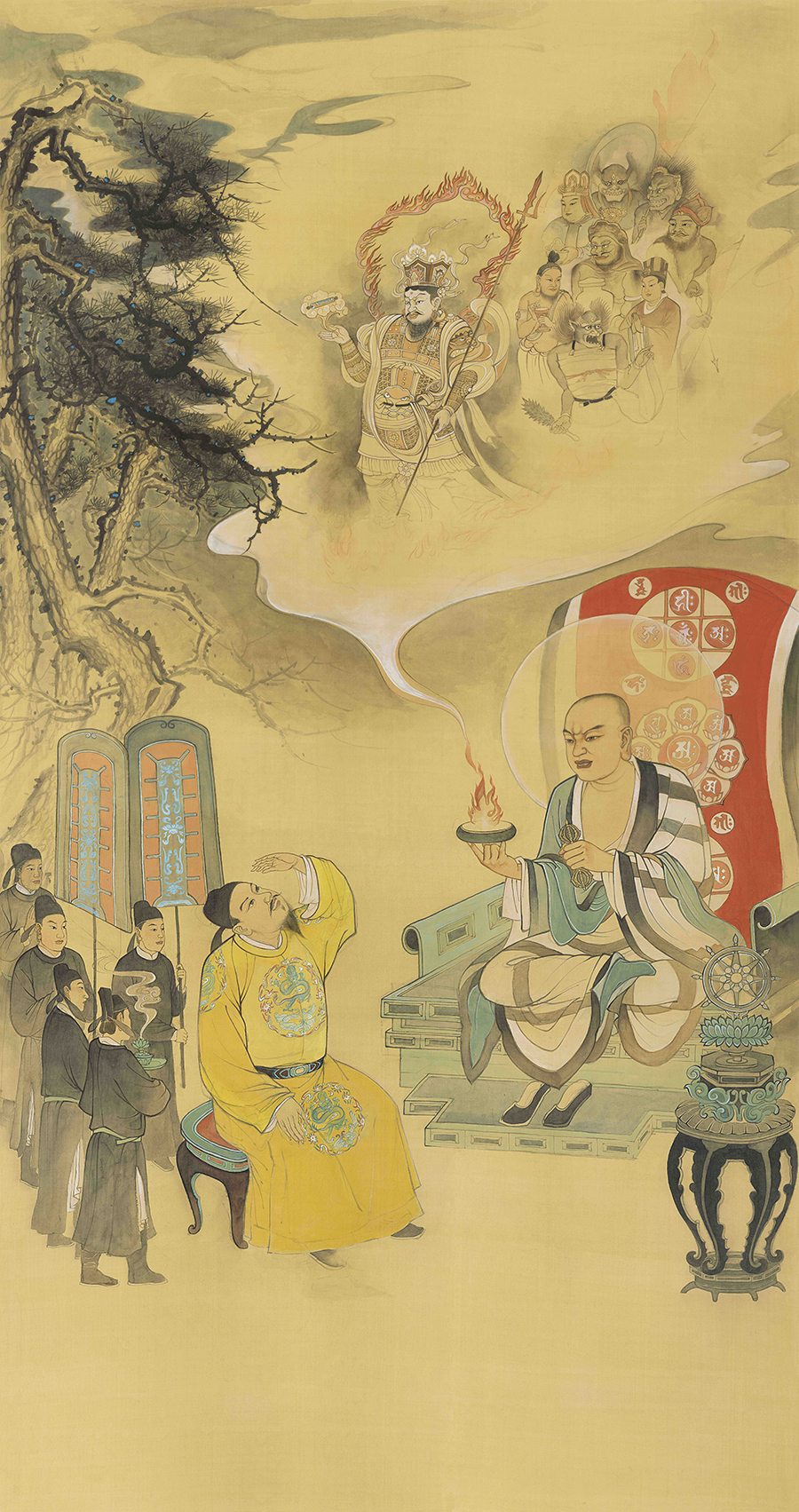
唐密祖师不空三藏
作者:金珂玄雷上师与弟子共创
年代:2014 年【甲午年】
尺寸:70cm x 138cm
材质:绢本设色
题款:
不空三藏 三朝国师 护持仁王 披荆斩棘
水火刀兵 灾难止息 风雨吉时 国泰民安
甲午秋于广西十万大山金莲湖金珂玄雷上师与金珂佛子共绘
不空(公元705-774),十四岁跟随金刚智入大唐。历任玄宗、肃宗、代宗三朝灌顶国师。作品描绘了天宝十二年,西番、大石、康居三国兵围凉州,玄宗皇帝请不空祈请神兵救急,于是不空结坛唱诵仁王密语。一会儿,北方毘沙门天王长子天神身披甲胄而来,不空诵密语发遣该神祗。四月二十日西凉守将奏报,二月十一日城东北三十许里,云雾间出现身材伟岸之神兵,城北门楼有一光明天王,怒视番帅,天鼓声角凌云而至,吓得西番兵马卷甲而逃。
Amoghavajra — Lineage Master of Sino Esoteric Buddhism
Creator: Vajra Master Jinke Xuanlei and Disciples
Year: 2014 (Year of Wood Horse)
Dimensions: 70cm x 138cm
Material: Ink and color on silk
Amoghavajra, Tripiṭaka Master,
National Preceptor to three emperors.
Defender of the Humane King Sutra,
Clearing obstacles with resolute strength.
Through water, fire, blades, and conflict,
Disasters are quelled, and harmony restored.
In auspicious times of wind and rain,
The nation prospers, and its people live in peace.
Amoghavajra (705–774) entered Tang China at the age of fourteen, accompanying his teacher Vajrabodhi. Throughout his lifetime, he served as the National Preceptor to three Tang emperors—Xuanzong, Suzong, and Daizong. Renowned for his mastery of esoteric Buddhism, Amoghavajra was instrumental in spreading Vajrayāna teachings and using his spiritual prowess to protect the nation during times of crisis.
This artwork depicts an extraordinary episode in 754 CE (Tianbao Year 12) when Liangzhou was under siege by the armies of Xifan, Dashi, and Kangju. Emperor Xuanzong turned to Amoghavajra for assistance, requesting his intervention through esoteric rituals. In response, Amoghavajra established a sacred mandala and chanted the profound incantations of the Humane King Sutra.
The painting vividly portrays the miraculous events that followed. As Amoghavajra recited the sacred mantras, Hevenly King Vaiśravaṇa’s eldest son—a mighty divine warrior clad in resplendent armor—manifested from the heavens. Guided by Amoghavajra’s spiritual authority, the deity led his divine forces into battle. On April 20, Liangzhou’s defenders reported a miraculous vision: a colossal army of divine warriors emerging from the clouds, led by a luminous Heavenly King standing atop the northern gate tower. The king’s piercing gaze struck fear into the enemy generals, and the thunderous sound of celestial war drums and horns caused the besieging forces to retreat in chaos.
This painting masterfully captures the glory and spiritual significance of Amoghavajra’s intervention. The composition combines historical fidelity with esoteric symbolism, illustrating his role as both a guardian of the Dharma and a protector of the nation. Through its dynamic imagery and profound narrative, the artwork celebrates the enduring legacy of Amoghavajra’s compassion, wisdom, and unwavering commitment to safeguarding the teachings of Sino Esoteric Buddhism.