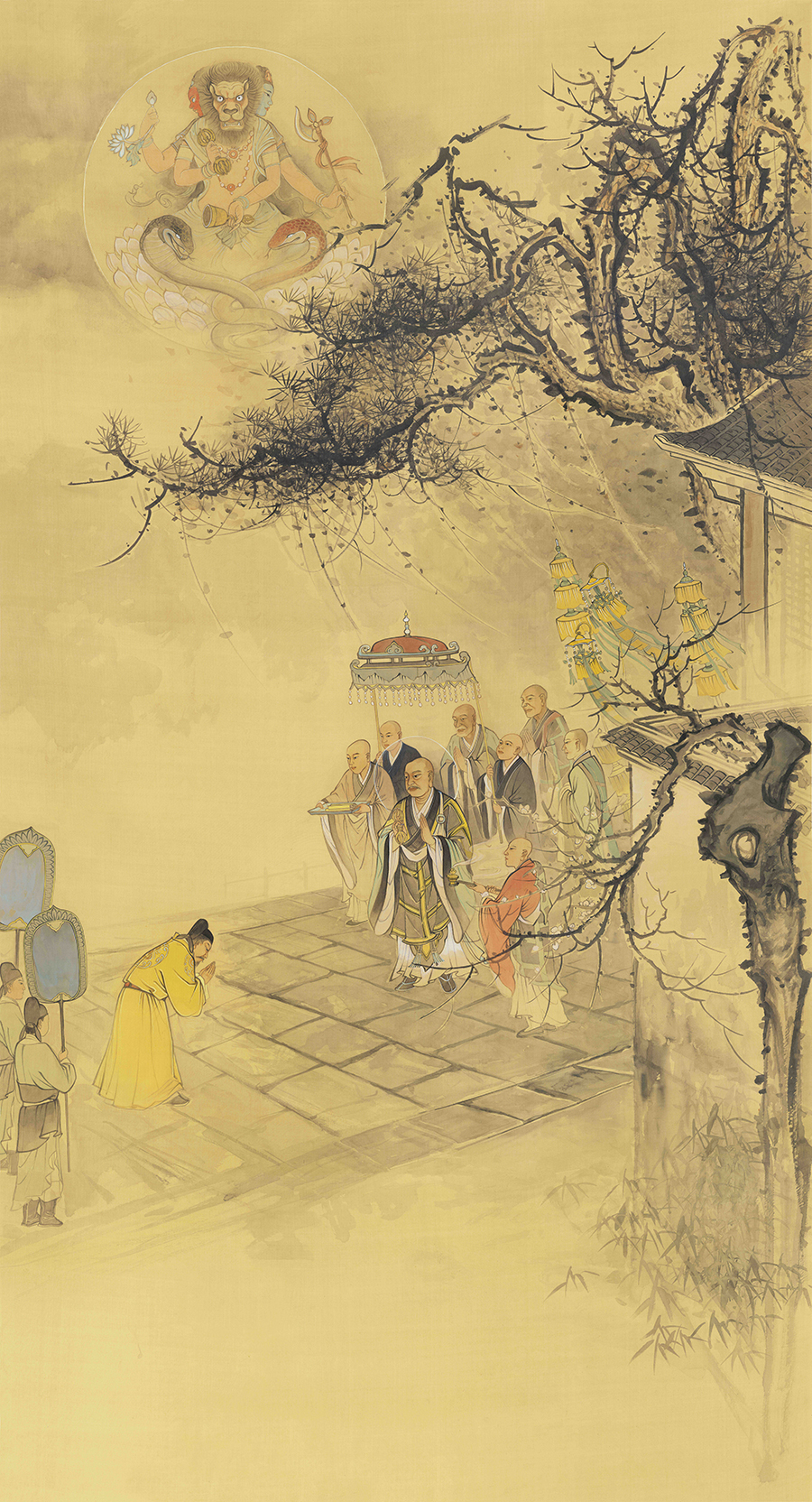
唐密祖师惠朗
作者:金珂玄雷上师与弟子共创
年代:2014 年【甲午年】
尺寸:70cm x 138cm
材质:绢本设色
题款:
国师惠朗阿阇黎 不空上师明授记
代宗皇帝礼器重 译经传法达真乘
功德圆满因缘谢 隐入深山度有缘
甲午秋于广西十万大山金珂玄雷上师与金珂佛子共绘
惠朗(公元662-725),唐大历九年六月,不空奏准制定大兴善寺翻经院灌顶道场和文殊阁道场持诵僧二十一人,以惠朗为诸弟子之首,奏文:“其惠朗等二十一人并久探秘藏,深达真乘,戒行圆明,法门标准。”不空圆寂后,唐代宗敕令“僧惠朗专知检校院事,兼及教授后学,一奠一契有次第者闻奏”。《行状》载“僧弟子惠朗次承灌顶之位。” 惠朗继位之后,即在大兴善寺翻经院主持密宗教务,受代宗器重,十一月赐紫绶袈裟。 大历十三年十一月,惠朗奉敕往五台山修功德。建中二年十一月,在惠朗的主持操办下,朝廷为不空立碑于大兴善寺,永资纪念。缘谢则灭隐,具因则生现,观到时代法性的因缘所致,惠朗祖师随后隐入深山,以法身应化秘密传承的方式延续唐密法种……
Huilang — Lineage Master of Sino Esoteric Buddhism
Creator: Vajra Master Jinke Xuanlei and Disciples
Year: 2014 (Year of Wood Horse)
Dimensions: 70cm x 138cm
Material: Ink and color on silk
National Preceptor Ācārya Huilang,
Recognized by Master Amoghavajra’s enlightened prophecy.
Revered by Emperor Daizong for translating and transmitting the Dharma,
Bringing the True Vehicle to light.
When merit and virtue were fulfilled, he withdrew,
Retreating into the mountains to guide those with karmic ties.
Huilang (662–725), a preeminent figure in Sino Esoteric Buddhism, played a critical role in preserving and propagating the lineage following the passing of his master, Amoghavajra. In the ninth year of the Dali era (774 CE), Amoghavajra successfully petitioned Emperor Daizong to establish the Sutra Translation Fane Abhiṣeka Bodhimandala and the Mañjuśrī Pavilion Bodhimandala at Daxingshan Monastery. Huilang was appointed to lead twenty-one monks tasked with upholding the esoteric teachings. The petition described Huilang as one who had deeply explored esoteric mysteries, comprehended the supreme path, and embodied exemplary discipline and understanding of the Dharma.
After Amoghavajra’s passing, Emperor Daizong issued a decree elevating Huilang to oversee monastic affairs, ensuring the preservation and continuation of the Abhiṣeka lineage. The Xingzhuang record confirms his appointment as the next Abhiṣeka Master, making him the third successor in the Tang Esoteric lineage. Huilang’s leadership at Daxingshan Monastery was marked by his dedication to maintaining and transmitting esoteric practices, earning him profound trust and honor from Emperor Daizong. His contributions were formally recognized when the Emperor bestowed upon him the Purple Ribbon Kāṣāya in 776 CE.
In 778 CE, Huilang received an imperial order to undertake meritorious practices at Wutai Mountain. Observing the evolving conditions of the Dharma and karmic connections, Huilang later retreated into the seclusion of deep mountains. Through the Dharmakāya embodiment and secret transmissions, he continued to safeguard the teachings of Tang Esoteric Buddhism, ensuring their survival and spiritual potency for future generations.
This artwork vividly portrays Huilang’s profound spiritual journey and dedication to the Dharma, blending historical depth with esoteric symbolism. It captures the enduring legacy of a master who bridged the spiritual needs of an empire and the timeless truths of esoteric Buddhism.